Let’s be honest: traditional food tracking is exhausting. You open the app, stare at a search bar, type in “chicken breast,” scroll through 47 nearly identical entries, guess the portion size, add sides one by one, and repeat this process three to five times a day. By the end of the week, you are burned out—not because you lack discipline, but because the system demands too much effort for too little reward.
That is exactly the problem Kaifit was built to solve.
The real pain points of manual food logging
If you have ever quit a tracking app, you probably recognize these frustrations:
- Time-consuming entries
Every meal becomes a multi-step project: search the food, pick the right database entry, adjust theportion, add each ingredient separately if it is a mixed dish. What should take 10 seconds ends up taking several minutes, multiple times a day. - Inaccurate or incomplete databases
You are looking for “grilled chicken wrap with veggies,” but the database has 15 versions with different calorie counts and no way to know which one matches what youactually ate. Homemade meals and restaurant dishes are even worse—often missing entirely or wildly inconsistent. - Forgetting to log meals
Life gets busy. You eat lunch on the go, forget to log it right away, and by dinner you are trying to remember what you had six hours ago. The more friction there is in logging, the easier it is to skip it altogether.
When tracking feels like work, consistency drops. And without consistency, the benefits of tracking disappear fast.
How Kaifit removes the friction
Kaifit is designed around one core idea: logging should be faster and easier than not logging. Here is how we make that happen.
1. AI photo recognition logs meals in seconds
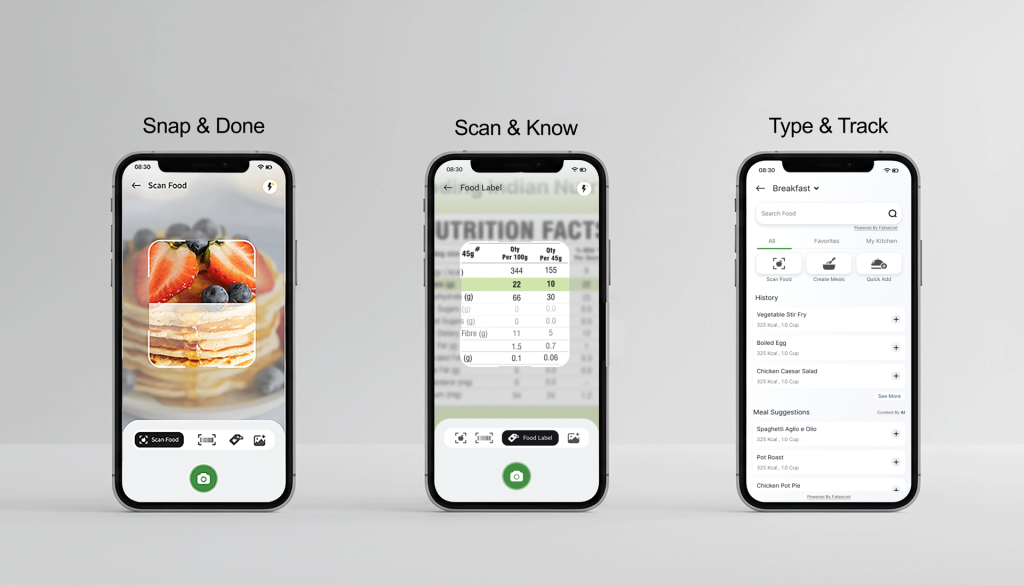
Instead of typing and searching, just snap a picture. Kaifit’s AI analyzes the image, identifies the foods on your plate, and estimates calories, macros, and portion sizes automatically. You review, adjust if needed, and you are done—usually in under 10 seconds.
This is not just about convenience. Photo logging drastically cuts the time and mental effort required to track, which means you are far more likely to stay consistent over weeks and months. And consistency is what actually drives results.
2. Barcode scanner and label reader for packaged foods
For snacks, drinks, and anything with a nutrition label, Kaifit’s barcode scanner pulls the exact product data instantly. No searching, no guessing, no scrolling through generic entries that might not match. Scan, confirm, log—done.
3. Smart reminders help you stay consistent
Forgetting to log is one of the biggest reasons people fall off track. Kaifit can send you gentle reminders at meal times so logging becomes a quick, automatic habit instead of something you have to remember on your own. Over time, it becomes second nature.
Kaifit adapts to your life, not the other way around
Traditional trackers assume you have unlimited time, perfect memory, and endless patience. Kaifit assumes you are a real person with a job, a social life, and days that do not go exactly as planned.
Whether you are:
- Grabbing lunch between meetings
- Eating out with friends
- Cooking at home with your family
- Traveling or on the road
Kaifit makes logging fast and flexible enough to fit into your actual routine. You are not changing your life to use the app; the app is built to work with the life you already have.
Why this matters for your progress
Research consistently shows that self-monitoring—tracking what you eat—is one of the most effective tools for weight management and healthier eating. But it only works if you can stick with it long enough to see patterns, make adjustments, and build better habits.
By cutting out the tedious parts of food logging, Kaifit makes it realistic to track consistently. And when you track consistently, you start to notice:
- Which meals keep you satisfied versus hungry an hour later.
- Where hidden calories are sneaking in.
- How your eating shifts on busy days, weekends, or stressful weeks.
That awareness is what drives real, sustainable change—not one perfect day of tracking, but many normal days that add up over time.
The bottom line
Manual food logging feels hard because it is hard. Kaifit fixes that by automating the tedious parts, cutting logging time by 80% or more, and making consistency actually achievable.
Tracking should support your goals, not become a second job. With Kaifit, it finally does.
How accurate is AI photo recognition compared to manual logging?
Photo recognition provides quick estimates that are usually close enough for consistent tracking. You can always review and adjust portions or items if something looks off. The goal is not perfection—it is making logging fast enough that you actually do it regularly, which matters more than getting every calorie exact.
What if the AI doesn't recognize my food correctly?
You can manually edit or correct any item the AI identifies. Over time, as you log more meals, the system gets better at recognizing your common foods and preferences. You stay in full control while the AI handles the heavy lifting.
Do I still need to weigh my food for accurate tracking?
Not necessarily. Weighing food is the most precise method, but it is also time-consuming and not realistic for most people long-term. Kaifit’s photo logging and portion estimates are designed to give you useful, actionable data without requiring a food scale at every meal.
How does the barcode scanner work?
Point your phone camera at the barcode on any packaged food or drink. Kaifit scans it, pulls the exact nutrition data from the product database, and adds it to your log instantly. It works for most branded items available in stores.
Will reminders actually help me remember to log?
Yes. Studies on habit formation show that timely reminders significantly improve consistency, especially in the early stages of building a new habit. You can customize when and how often you want reminders, so they feel helpful instead of annoying.