When you first start tracking your nutrition, the biggest question isn’t what to eat—it’s how much. Generic calorie calculators might tell you to eat 2,000 calories per day, but is that based on your actual body composition, activity level, and goals? Probably not. The difference between hitting your fitness targets and spinning your wheels often comes down to one thing: truly personalized calorie and macro targets that adapt to your unique metabolism and lifestyle. Unlike the one-size-fits-all approach that leaves most people frustrated, AI-powered personalization considers dozens of variables to create nutrition targets you can actually achieve.
Why Generic Calorie Targets Fail Most People
Walk into any gym and you’ll hear the same advice: “Just eat 2,000 calories” or “Try a 40-30-30 macro split.” The problem? Your body doesn’t care about generic formulas.
Traditional calorie calculators use the Mifflin-St Jeor equation to estimate your Basal Metabolic Rate (BMR)—the calories your body burns at rest—then multiply it by a rough activity factor. While this provides a starting point, it often misses the mark by 300-350 calories per day. For someone trying to lose fat or build muscle, that margin of error can completely derail your progress.
Calculation Method | Accuracy | Personalization Level | Adapts to Progress? |
Generic Online Calculator | ±300-350 cal/day | Basic (age, weight, height) | No |
Static Macro Formula | ±250-300 cal/day | Moderate (adds activity level) | No |
AI-Powered Personalization | ±50-100 cal/day | Advanced (metabolism, body comp, trends) | Yes |
Even worse, these static targets don’t account for metabolic adaptation. As you lose weight, your body requires fewer calories. As you build muscle, you need more protein. Generic calculators can’t capture these dynamic changes, leaving you eating the wrong amounts at the wrong times.
🚀 Ready to Stop Guessing?
Join thousands who've discovered what truly personalized nutrition can do. Get AI-powered targets that adapt to your unique body.
Unlock Early Access TodayThe Science Behind True Personalization
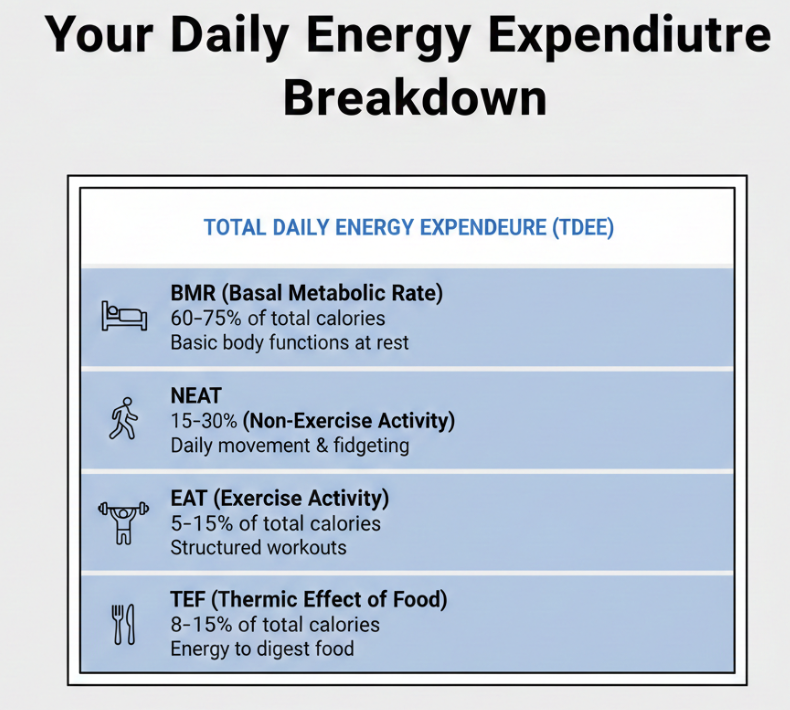
Effective personalized nutrition starts with understanding your Total Daily Energy Expenditure (TDEE) the actual number of calories your body burns in a 24-hour period. But TDEE isn’t just about your BMR and activity level. It accounts for:
Non-Exercise Activity Thermogenesis (NEAT): The calories you burn through daily movement like walking to your car, typing at your desk, or cleaning your home. NEAT can vary by hundreds of calories between two people with identical exercise routines.
Thermic Effect of Food (TEF): Your body burns calories digesting food, with protein requiring significantly more energy to process than carbs or fats. This is why higher-protein diets often produce better body composition results.
Exercise Activity Thermogenesis (EAT): The calories burned during structured exercise, which varies dramatically based on intensity, duration, and your current fitness level.
Smart AI systems track how your body actually responds to your nutrition program, continuously adjusting your targets based on real data rather than theoretical equations. If you’re losing weight faster than expected, your targets adjust upward to prevent muscle loss and metabolic slowdown. If progress stalls, the system identifies whether you need fewer calories or simply better macro distribution.
Why Macros Matter More Than Calories Alone
Focusing solely on total calories is like judging a book by its page count. A 400-calorie meal of grilled salmon with vegetables affects your body completely differently than 400 calories of cookies—even though the energy content is identical.
Macronutrient | Calories per Gram | Primary Function | Optimal Daily Intake |
Protein | 4 calories | Muscle repair & growth, satiety | 0.8-1.0g per lb body weight |
Carbohydrates | 4 calories | Energy for training & recovery | 0.75-2.0g per lb body weight |
Fats | 9 calories | Hormone production, nutrient absorption | 0.2-0.4g per lb body weight |
Protein intake drives muscle preservation and satiety. Research consistently shows that consuming 0.8-1.0 grams of protein per pound of body weight helps maintain lean mass during fat loss while keeping you fuller longer. Yet most generic calculators ignore your lean body mass entirely, potentially recommending inadequate protein that leads to muscle loss and increased hunger.
Carbohydrates fuel your training intensity and support recovery. Active individuals need significantly more carbs than sedentary people, but traditional calculators treat a marathon runner and an office worker with the same height and weight as nearly identical. Smart nutrition apps integrate your actual activity patterns to ensure your carb intake matches your energy demands.
Dietary fat supports hormone production and nutrient absorption. Going too low on fat can compromise testosterone production, disrupt sleep quality, and leave you feeling drained. Personalized targets ensure you consume adequate fat while leaving room for the carbs and protein your body needs most.
How KaiFit Creates Your Personal Nutrition Blueprint
Unlike apps that ask three questions and spit out cookie-cutter macros, KaiFit’s AI-powered system analyzes multiple data points to create targets specifically for your body:
The Personalization Process
Phase | What KaiFit Analyzes | Result |
1. Initial Assessment | Current weight, height, age, body composition goals | Establishes your baseline TDEE |
2. Lifestyle Mapping | Activity patterns, workout frequency, daily movement | Adjusts energy needs for your reality |
3. Preference Integration | Dietary restrictions, food preferences, meal timing | Creates achievable targets you’ll actually follow |
4. Continuous Learning | Meal photos, progress data, weight trends | Refines targets based on real results |
5. Adaptive Adjustment | Metabolic adaptation, progress rate, energy levels | Updates macros to prevent plateaus |
Your starting point begins with comprehensive onboarding that captures your current weight, body composition goals, activity patterns, dietary preferences, and lifestyle factors. The system then establishes your baseline TDEE using advanced calculations that consider your lean body mass and metabolic characteristics.
As you track meals through photo logging or manual entry, KaiFit’s AI learns how your body responds. If you’re consistently hitting your targets but not seeing expected progress, the algorithm investigates whether metabolic adaptation has occurred or whether your activity level has shifted. Rather than leaving you guessing, the system provides clear guidance on adjusting your nutrition.
Integration with health apps and wearables brings additional precision. When you crush a high-intensity workout or spend the day moving furniture, your calorie target adjusts automatically to fuel recovery without sabotaging your progress. This dynamic approach eliminates the guesswork that causes most nutrition plans to fail within weeks.
Real Example: How Personalization Changes Everything
Let’s look at two people with identical stats but different lifestyles:
Sarah vs. Mike: Same Stats, Different Needs
Both: 30 years old, 5’8″, 165 lbs, goal to lose 10 lbs
Factor | Sarah (Office Worker) | Mike (Construction Worker) |
Daily Steps | 4,000 steps | 12,000 steps |
Job Activity | Desk work, 8 hrs sitting | Physical labor, constant movement |
Formal Exercise | 3x/week gym (45 min) | 1x/week pickup basketball |
NEAT Calories | ~300 cal/day | ~800 cal/day |
Personalized TDEE | 1,950 calories | 2,650 calories |
Fat Loss Target | 1,450 calories (-500) | 2,150 calories (-500) |
Daily Protein | 132g (0.8g/lb) | 165g (1.0g/lb higher for manual labor) |
Generic Calculator Says: Both should eat 2,000 calories
Reality: Sarah would barely lose weight. Mike would be starving and lose muscle mass.
This is why personalization isn’t optional—it’s the difference between success and frustration.
Your Body Deserves Better Than Generic Advice
Experience what truly personalized nutrition feels like. Track effortlessly with AI photo scanning and watch your targets adapt as you progress.
Adapting Your Targets as Your Body Changes
The biggest advantage of personalized nutrition isn’t just getting accurate starting targets—it’s having a system that evolves with you. Your nutritional needs change as you progress, and static calculators can’t keep up.
The Adaptation Timeline: What to Expect
Weeks 1-2: Initial Response
- Body releases stored water and glycogen
- Energy levels stabilize to new intake
- Hunger patterns begin to normalize
- Weight changes are most dramatic
Weeks 3-6: Active Fat Loss Phase
- Consistent progress at target rate (0.5-1% body weight per week)
- NEAT may decrease slightly as body adapts
- Muscle preservation critical—protein intake non-negotiable
- Targets remain relatively stable
Weeks 7-12: Metabolic Adaptation Begins
- Body becomes more efficient at current calorie level
- Progress may slow without adjustment
- AI detects slowdown and reduces calories by 50-100
- Activity-adjusted targets maintain momentum
Week 13+: Maintenance Transition
- Gradual reverse dieting increases calories
- Metabolism adapts upward to new maintenance
- Targets shift from deficit to sustainability
- Body composition improvements continue with proper macros
During the first weeks of fat loss, your body releases stored energy relatively easily. But as you get leaner, metabolic adaptation kicks in. Your body becomes more efficient, burning fewer calories for the same activities. Without adjustment, you’ll hit a frustrating plateau where the deficit that worked initially no longer produces results.
Similarly, as you build muscle through consistent training, your calorie and protein requirements increase. More metabolically active tissue means higher energy expenditure at rest. Failing to adjust your targets upward can limit your muscle-building potential and leave gains on the table.
Smart personalization accounts for these physiological realities. Rather than following a rigid meal plan for months, AI-powered systems detect when your progress deviates from expectations and suggest precise adjustments. This responsiveness is what separates people who achieve lasting transformations from those who give up after a few weeks of stagnation.
Making Personalized Nutrition Sustainable
The most accurate calorie targets in the world won’t help if you can’t stick to them. True personalization extends beyond numbers to consider your lifestyle, preferences, and psychological relationship with food.
Flexible vs. Rigid Tracking: What Actually Works
Approach | Rigid Macro Tracking | Flexible Personalized Targets |
Daily Protein | Must hit exact 165g | Hit 155-175g range |
Carb/Fat Split | Exact ratio required (40/30) | Flexible within calorie budget |
Restaurant Meals | Stressful, requires exact matches | Estimate closely, adjust next meal |
Social Events | Often skipped or guilt-inducing | Built into weekly average |
Adherence Rate | 40-50% quit within 4 weeks | 75-80% still tracking at 12 weeks |
Long-Term Success | Low—too restrictive | High—sustainable habits formed |
Flexible tracking approaches recognize that life happens. You don’t need identical macros every day to make progress—you need consistency with the fundamentals. As long as you hit your calorie target and protein minimum most days, the exact distribution of carbs and fats can fluctuate based on your preferences and circumstances. This flexibility prevents the all-or-nothing mindset that derails rigid diet plans.
AI-powered meal logging eliminates the tedious manual entry that causes most people to quit tracking after a few weeks. Simply snap a photo of your meal and receive instant nutritional analysis. The system learns your eating patterns, making future logging even faster while providing personalized meal suggestions that fit your targets and taste preferences.
Education builds long-term success. Rather than blindly following numbers, personalized systems help you understand why certain targets work for your body. You learn which foods satisfy your hunger, how different macro distributions affect your energy levels, and what adjustments produce the best results. This knowledge empowers you to make smart nutrition decisions even when life throws curveballs.
Common Personalization Mistakes to Avoid
Even with access to sophisticated tools, people often undermine their results by making these critical errors:
The 5 Biggest Personalization Pitfalls
Mistake #1: Changing Targets Too Frequently
- The Problem: Adjusting macros every 3-4 days based on scale fluctuations
- The Fix: Give each adjustment 2-3 weeks to show real trends
- Why It Matters: Daily weight fluctuates 2-5 lbs from water, food volume, and hormones
Mistake #2: Ignoring Protein Minimums
- The Problem: “Flexible” becomes “whatever fits my calories”
- The Fix: Protein target is non-negotiable; flexible with carbs/fats only
- Why It Matters: Inadequate protein causes muscle loss, increased hunger, poor recovery
Mistake #3: Treating Targets as Rigid Rules
- The Problem: Guilt and stress when you can’t hit exact macros
- The Fix: Focus on weekly averages, not daily perfection
- Why It Matters: Psychological stress increases cortisol and undermines progress
Mistake #4: Not Tracking on “Bad” Days
- The Problem: Only logging when you eat “perfectly”
- The Fix: Track everything—AI needs complete data to adapt properly
- Why It Matters: Partial data leads to inaccurate target adjustments
Mistake #5: Forgetting About Food Quality
- The Problem: Hitting macros with only ultra-processed foods
- The Fix: 80% whole foods, 20% flexibility for treats and convenience
- Why It Matters: Micronutrients, fiber, and satiety matter for health and adherence
Your Next Steps to Personalized Nutrition Success
Generic diet advice has failed you long enough. You deserve nutrition targets based on your actual body, lifestyle, and goals—not outdated formulas that treat everyone the same.
Your 7-Day Personalized Nutrition Kickstart
Day | Action Step | Why It Matters |
Day 1 | Download KaiFit and complete onboarding | Get your baseline personalized targets |
Day 2-3 | Track normal eating without changes | Establish your current patterns and habits |
Day 4 | Review AI recommendations and set first targets | Understand your starting point |
Day 5-7 | Begin hitting daily macros with photo logging | Build tracking habit with instant feedback |
Start by understanding your current baseline. Track your typical food intake for a few days without making changes. This reveals your natural eating patterns and provides a realistic starting point for adjustments.
Choose tools that prioritize accuracy and adaptability. KaiFit’s AI-powered platform combines cutting-edge nutrition science with intuitive photo-based tracking to make personalized nutrition effortless. No more guessing portion sizes or searching massive food databases—just snap, track, and let the AI handle the complex calculations.
Commit to consistency over perfection. Your personalized targets work when you follow them most of the time, not when you achieve flawless adherence. Focus on building sustainable habits rather than pursuing an unrealistic standard that leads to burnout.
The difference between another failed diet attempt and lasting transformation often comes down to one factor: having nutrition targets that actually fit your unique physiology and lifestyle. Stop settling for generic advice that ignores your individual needs. Your body deserves better.
Frequently Asked Questions
How often should I adjust my personalized calorie and macro targets?
Review your targets every 2-4 weeks based on progress indicators like weight trends, body composition changes, energy levels, and training performance. Small adjustments of 50-100 calories or 5-10 grams of protein are typically sufficient. AI-powered apps like KaiFit make these adjustments automatically based on your logged data and progress rate, removing the guesswork from when and how much to adjust.
Can personalized targets work for any diet approach—keto, plant-based, or intermittent fasting?
Absolutely. Personalization focuses on total calories and macronutrient distribution, which applies regardless of your dietary philosophy. Whether you’re eating keto, vegan, or following time-restricted feeding, personalized targets ensure you consume appropriate amounts to support your goals within your chosen framework. KaiFit adapts to your preferences while maintaining the protein, calorie, and nutrient balance your body needs.
What if I can't hit my protein target without protein shakes?
While whole foods should form the foundation of your diet, protein supplements are a practical tool for reaching higher targets. Focus on protein-rich whole foods like lean meats, fish, eggs, dairy, and legumes first, then use protein powder to bridge any remaining gap. Most people can comfortably reach 0.8-1.0 grams per pound of body weight with strategic food choices and one daily shake if needed. The key is convenience without compromising whole food nutrition.
How accurate are AI-powered calorie estimations from food photos?
Leading AI nutrition apps like KaiFit achieve approximately 90% accuracy for common foods and meals, which is sufficient for effective progress tracking. The key is consistency—using the same method daily provides reliable trend data even if individual meal estimates have slight variations. You can always manually adjust entries when you know exact portion sizes or ingredients. Most users find photo logging accurate enough to hit their goals while saving 10-15 minutes per day compared to manual entry.
Will my metabolism slow down if I follow a calorie deficit for too long?
Metabolic adaptation is real but often overstated. Your metabolism will decrease slightly as you lose weight (fewer pounds to maintain = fewer calories needed), and your body may become more efficient at current calorie levels. However, personalized systems detect this adaptation early and make gradual adjustments to maintain progress. Taking periodic diet breaks where you eat at maintenance for 1-2 weeks can also help minimize metabolic slowdown during extended fat loss phases.
How do I know if my personalized targets are working?
Track multiple progress indicators beyond just the scale: weekly average weight trends (aim for 0.5-1% body weight loss per week), progress photos every 2 weeks, measurements of key areas, energy levels during workouts, hunger and satiety between meals, and strength maintenance or gains in the gym. If you’re seeing progress in most of these areas, your targets are working. If progress stalls across multiple metrics for 2-3 weeks, it’s time for an adjustment.