Most fitness content focuses on transformation: lose 20 pounds, build muscle fast, get shredded for summer. But what about the people who are already where they want to be? What if your goal is not to change your weight, but to keep it exactly where it is, without obsessing, restricting, or constantly second-guessing your meals?
That is what maintenance mode is all about, and it is one of the most underrated, underserved goals in nutrition. Kaifit makes staying stable simple, stress-free, and sustainable.
What maintenance really means
Maintenance is not about eating the exact same calories every single day and never fluctuating. That is impossible and unnecessary. Real maintenance means keeping your weight stable over time, within a small natural range, while living your actual life.
Your weight will shift day to day based on:
Water retention from salty meals, workouts, or hormones.
Digestive timing and how much food is currently in your system.
Stress, sleep, travel, and dozens of other factors.
A 2 to 4 pound fluctuation week to week is completely normal. Maintenance is about keeping your average weight steady over weeks and months, not obsessing over daily scale changes.
Why maintenance deserves attention
Maintenance often gets ignored because it is not dramatic. There is no “before and after” photo, no big transformation story. But staying stable is a real accomplishment, especially in a culture that constantly pushes people to change.
Maintenance is the right goal if:
You have reached a weight you feel good at and want to stay there.
You are happy with your body composition and do not want to bulk or cut.
You are done with dieting cycles and want long-term stability.
You want to eat intuitively but with a little structure to prevent slow creep in either direction.
Research shows that maintaining weight loss long-term is actually harder than losing weight in the first place. Most people who lose weight regain it within a few years, often because they stop tracking and lose awareness. The paper “Long-term weight loss maintenance” by Wing and Phelan (2005), published in The American Journal of Clinical Nutrition, highlights how consistent self-monitoring plays a key role in long-term weight stability. Light, flexible tracking during maintenance helps prevent that.
How Kaifit supports maintenance mode
Kaifit is designed to work for all three goals: lose, gain, and maintain. When you set your goal to “maintain,” the app calculates your maintenance calorie target and gives you the tools to stay stable without stress.
1. Kaifit suggests your maintenance calories based on your profile
When you complete Kaifit’s questionnaire, the app calculates your maintenance calorie target based on your age, gender, height, weight, and activity level. This gives you a smart starting point tailored to your body and lifestyle.
If you want, you can edit this target to match your preferences or real-world experience. Some people know from past tracking what works for them, and Kaifit lets you adjust accordingly.
Kaifit does not expect you to hit the exact same number every day. Some days you will eat a bit more, some days a bit less. As long as your weekly average stays near your target, your weight stays stable. This flexibility makes maintenance realistic and sustainable.
2. Weekly averages matter more than daily perfection
One higher-calorie weekend day does not ruin maintenance. One lighter weekday does not either. What matters is the pattern over time.
Kaifit’s dashboard lets you see your weekly intake average, so you can zoom out and check the bigger picture instead of panicking over one meal or one day. This reduces stress and keeps you focused on what actually matters: long-term consistency.
3. Light tracking keeps you aware without obsessing
You do not need to track every bite forever. Many people in maintenance mode track loosely, logging most meals, estimating portions, skipping the occasional snack, and that is enough to stay aware.
Kaifit’s photo logging and meal history make this easy. You snap a picture, confirm, and move on. It takes seconds, not minutes, so tracking feels like a small checkpoint instead of a daily project.
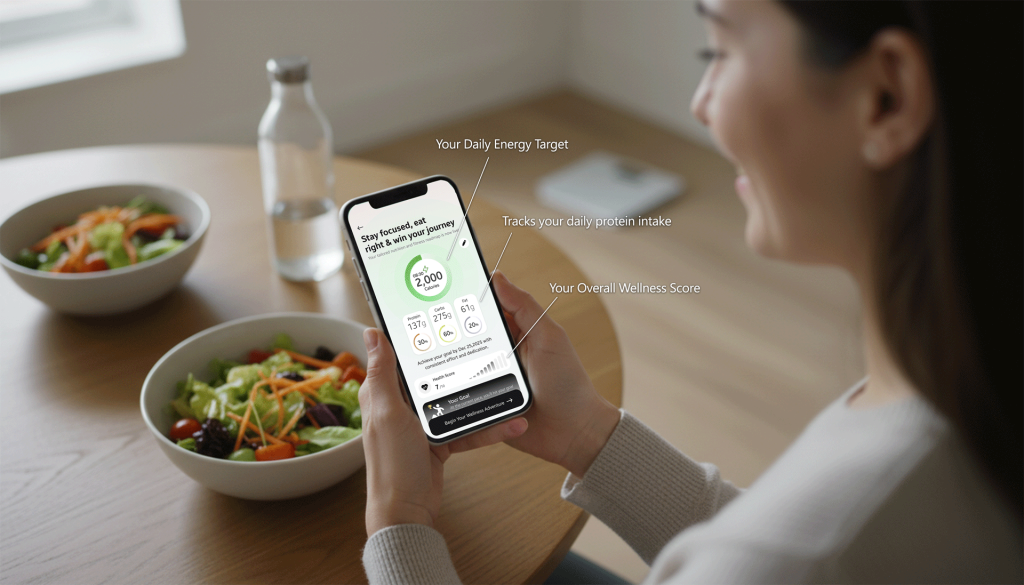
What maintenance tracking looks like in practice
Maintenance tracking is not about restriction or perfection. It is about awareness and balance. Here is what it might look like day to day.
Weekdays: structure with flexibility
You log most meals using Kaifit’s photo feature or meal history. You stay roughly within your maintenance range without stressing if you go 100 calories over or under. You keep an eye on protein to support muscle and satiety, but you are not micromanaging every macro.
Weekends: enjoy without derailing
You eat out, enjoy social meals, maybe have a couple of drinks or dessert. You might log loosely or skip logging entirely. Because your weekdays are consistent, a relaxed weekend does not throw off your weekly average.
Monthly check-ins: adjust if needed
Once a month, you look at your weight trend and weekly averages. If your weight is creeping up or down consistently, you make a small adjustment, add or subtract 100 to 200 calories daily, and course-correct early before it becomes a bigger issue.
This is proactive stability, not reactive panic.
The mental shift that makes maintenance work
Maintenance requires a different mindset than weight loss. You are not chasing progress; you are protecting stability. That means:
Celebrating consistency, not transformation.
Viewing tracking as a tool for awareness, not control.
Accepting that your weight will fluctuate within a small range, and that is healthy and normal.
Focusing on how you feel, energy, strength, confidence, not just the number on the scale.
Kaifit supports this mindset by keeping tracking simple, flexible, and judgment-free. You are not “failing” if you go over your range one day. You are gathering data so you can make small, informed adjustments when needed.
Why light tracking beats no tracking (or extreme tracking)
Some people try to maintain without any tracking, relying purely on intuition. That works for some, but many find their weight slowly creeps up or down over months without realizing it until clothes fit differently.
Others swing the opposite way and track obsessively, weighing every food and stressing over every calorie. That leads to burnout and an unhealthy relationship with food.
Light tracking with Kaifit is the middle path. You stay aware without being consumed. You have structure without rigidity. You catch small shifts early before they become big problems.
Common maintenance challenges (and how Kaifit helps)
Challenge: “I don’t know if I’m eating enough or too much”
Kaifit shows your daily and weekly intake so you can see if you are consistently above or below your target. Pair that with monthly weigh-ins, and you will know if adjustments are needed.
Challenge: “My weight keeps bouncing around”
Daily fluctuations are normal. Focus on the weekly and monthly trend, not single weigh-ins. Kaifit’s data helps you see the pattern, not just the noise.
Challenge: “I don’t want to track forever”
You do not have to. Many people track consistently for a few months to build awareness, then track loosely or intermittently to stay calibrated. Kaifit makes it easy to step in and out as needed.
Challenge: “I’m afraid if I stop tracking, I’ll gain it all back”
That fear is valid, especially if you have lost weight before and regained it. Light tracking during maintenance reduces that risk by keeping you aware without making food stressful. You are not white-knuckling it; you are checking in and adjusting as needed.
The Bottom line
Maintenance is not boring or passive. It is an active, intentional choice to stay where you are because that is where you want to be. Kaifit makes that choice easier by giving you the tools to stay stable without stress, obsession, or guesswork.
Whether you are maintaining after a weight loss journey, staying at a weight you have always felt good at, or simply done with the cycle of cutting and bulking, Kaifit works with you. Light tracking, weekly averages, and a flexible calorie target keep you stable long-term, so you can live your life without constantly worrying about your weight.
Maintenance is not the end of the journey. It is the goal worth protecting.
Frequently Asked Questions
How do I know what my maintenance calories are?
Kaifit calculates your estimated maintenance calories based on your age, gender, height, weight, and activity level from the questionnaire. You can also edit this target if you prefer to use a number based on your own experience or tracking history.
Do I need to track every single day during maintenance?
No. Many people track most days, log loosely on weekends, or track for a few weeks then take a break. The key is staying aware enough to catch trends early, not logging perfectly forever.
What if my weight goes up or down a few pounds?
Small fluctuations, 2 to 4 pounds, are completely normal due to water, digestion, hormones, and more. Focus on the trend over weeks, not daily changes. If your weight shifts consistently in one direction for a month, consider adjusting intake slightly.
Can I still enjoy treats and social meals in maintenance?
Absolutely. Maintenance is about balance, not restriction. You can enjoy higher-calorie meals and weekends as long as your weekly average stays near your target. Kaifit helps you see that bigger picture.
How is maintenance different from weight loss tracking?
n weight loss, you aim for a consistent calorie deficit. In maintenance, you aim to match your intake to your expenditure over time, so your weight stays stable. The tracking is lighter, more flexible, and focused on long-term patterns instead of weekly drops.